The science
Biology
Alcohol use disorder is a condition of the brain, not a failure of character. Here is what repeated drinking actually changes — and why being told to simply stop is asking the wrong system for help.
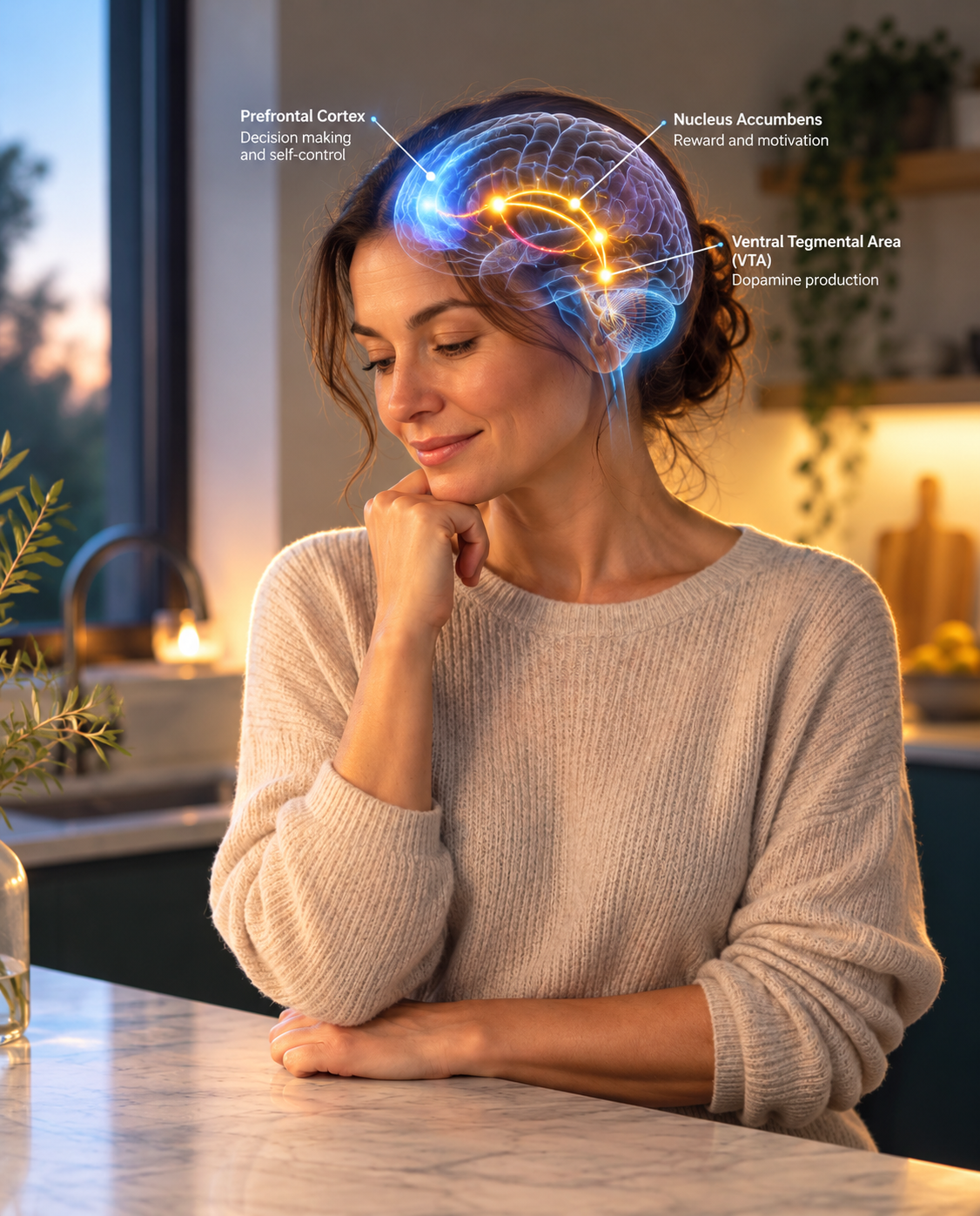
In one picture
The loop drinking builds — and why willpower fights it uphill
A drink lands
Dopamine surges in the reward circuit — the same signal the brain uses to mark survival rewards as worth repeating.
The brain adapts
To keep functioning, it turns down GABA (calming) and turns up glutamate (drive). This is tolerance.
A hotter baseline
Between drinks, the nervous system runs over-excited and on edge. Alcohol briefly quiets it — so the pull is strongest when you are tired or stressed.
Cues fire the craving
The kitchen at six, a hard day. Memory circuits replay the context, and the craving arrives as a body event before any conscious decision.
The uphill fight
Why willpower alone is so often not enough
The wrong tool for the job
Self-control lives in the prefrontal cortex — the very circuit chronic heavy drinking wears down first. Stress and poor sleep weaken it further.
The race is rigged
Cue-triggered craving peaks within the first minute or two. Deliberate reasoning is far slower — willpower starts half a lap behind.
The clock is long
GABA, glutamate and the stress system recalibrate over weeks to months — so the early stretch is hardest, not because the desire to change is weak.
Roughly half the risk of alcohol use disorder is inherited — biology doing the work, not character.
What repeated drinking does to a brain
None of this is a choice in the moment. It is the nervous system doing exactly what a nervous system is built to do: adapt to what you keep putting into it.
The reward circuit lights up
Alcohol nudges the brain's reward pathway, releasing dopamine in the nucleus accumbens. That signal is what makes the first drink feel like a good idea — the same circuit the brain uses to mark food and other survival signals as worth repeating.
The brake and the accelerator shift
Alcohol strengthens GABA, the brain's main calming signal, and dampens glutamate, its main excitatory one. You feel loosened, slower, less tense.
The brain corrects itself
To keep you functioning through regular drinking, the nervous system compensates: it turns down sensitivity to GABA and turns up glutamate. That is tolerance — and, between drinks, a nervous system left running hot and on edge.
The brain files the cues
Memory and emotion circuits record the context around drinking: the kitchen at six, a particular bar, a hard day. Later, the cue alone can fire the same anticipation — before you have consciously decided anything.
How Medications Help Reset Your Biology
Medication does not require you to want it more. It changes the signal you are fighting, so that the work around it — new routines, better sleep, harder conversations — becomes possible to do.
Naltrexone
Blunts the opioid signal that carries alcohol's reward, so drinking feels less compelling and cue-triggered craving loses some of its force. FDA-approved.
Acamprosate
Supports the brain's calming-versus-excitatory balance after stopping, easing the lingering restlessness that makes early recovery so uncomfortable. FDA-approved.
GLP-1 agonists (semaglutide)
Act on reward and satiety pathways. Early trials and observational studies point to reduced craving and fewer drinks per day. Off-label for this use, and clinician-guided.
Disulfiram
Blocks the enzyme that finishes breaking alcohol down, so a drink leaves acetaldehyde behind and brings a quick, unmistakable reaction. FDA-approved — a guardrail held from the outside, for people who want that line made firm.
General information, not medical advice, and not a diagnosis. Alcohol withdrawal can be dangerous — seek emergency care for severe symptoms. GLP-1 medications are not FDA-approved for alcohol use disorder; any use is off-label.
Recovery on the brain's clock
Timelines vary enormously — by history, health and support. This is the general shape of it.
First days
The nervous system is at its most over-excited once drinking stops. This is the step that can be medically dangerous — withdrawal needs supervision, not willpower.
First weeks
Sleep, appetite and mood begin to re-steady as calming and excitatory signalling drifts back toward balance. Cravings still arrive, but they tend to peak and pass sooner.
First months
Cue reactivity fades as new routines are repeated and old ones go unused. Stress tolerance comes back. This is when medication plus changed surroundings make the most difference.